Science · For ages 7–11

How Mirrors Work for kids, explained simply
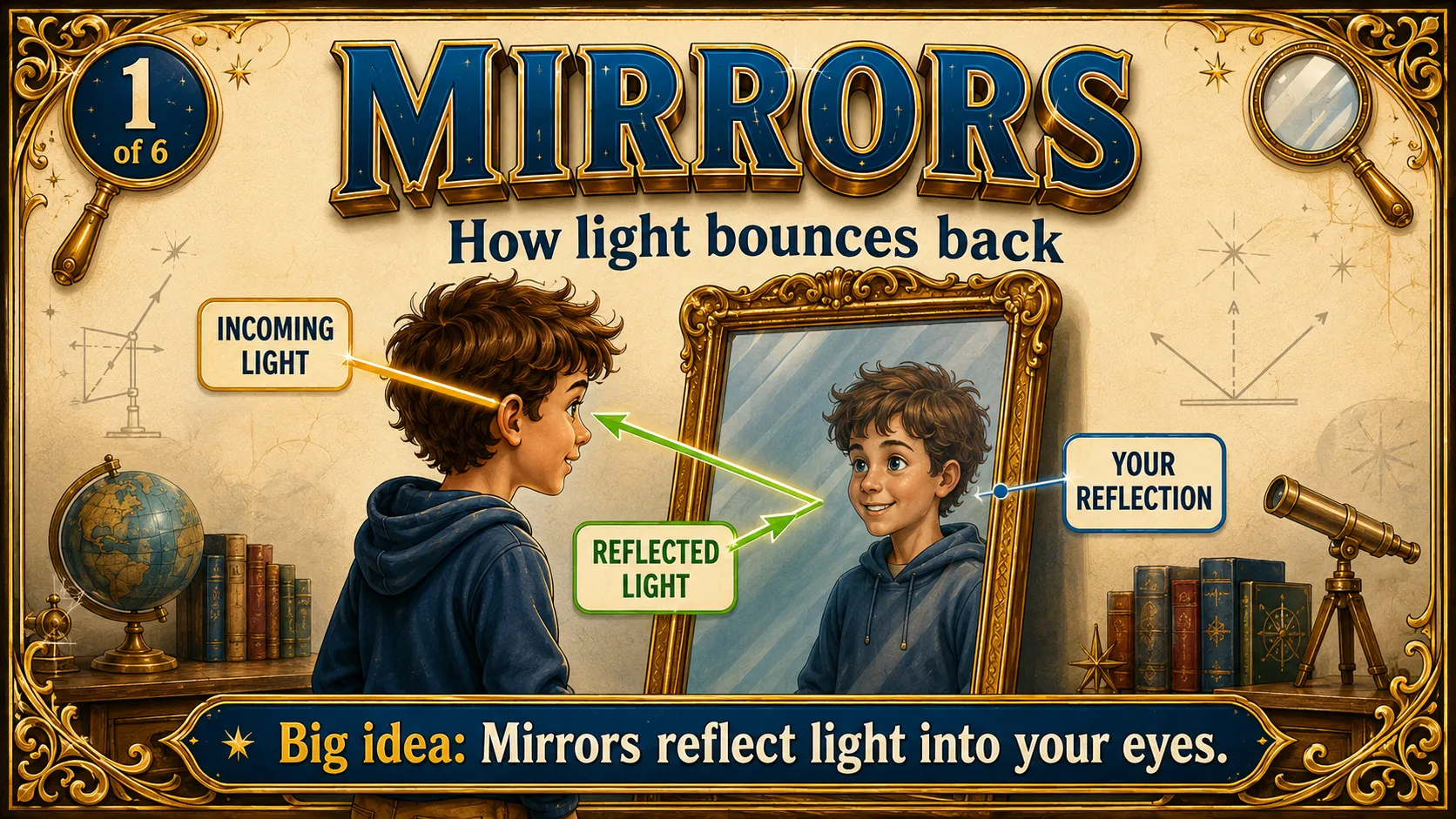
A mirror works by reflecting light in a very organised way. Most surfaces scatter light in all directions, so you can’t see yourself in them. A mirror’s surface is extremely smooth and has a shiny metal coating — usually silver or aluminium — that bounces light back at the exact same angle it arrived, giving you a clear reflection.
On Whizbee · carousel slide 1
The big ideas
Smooth surfaces reflect neatly
When light hits a rough surface like a wall, it bounces off in all different directions — this is called diffuse reflection. A mirror’s surface is so flat and smooth that every ray of light bounces back at exactly the same angle it came in. That orderly reflection is what creates a clear image.
The shiny coating does the work
A bathroom mirror is usually a piece of flat glass with a thin layer of silver or aluminium metal on the back. Metal reflects most of the light that hits it rather than letting it pass through, which is why the coating makes such a clear, bright reflection.
The angle in equals the angle out
There’s a rule: the angle at which light hits a mirror equals the angle at which it bounces back. This is called the law of reflection. It’s why you can use a mirror to bounce a beam of light exactly where you want it to go.
A quick quiz
1. Why can you see yourself in a mirror but not in a painted wall?
Choices: Walls are too dark · Mirrors reflect light in an organised way; walls scatter it in all directions · Mirrors make their own light
Answer: Mirrors reflect light in an organised way; walls scatter it in all directions. A rough wall bounces light in random directions (diffuse reflection), so no clear image forms. A mirror’s smooth surface reflects every ray back at the same angle, creating a sharp reflection.
2. What is on the back of most bathroom mirrors that makes them work?
Choices: A thin layer of metal (silver or aluminium) · A light source · A layer of water
Answer: A thin layer of metal (silver or aluminium). A thin coating of reflective metal — usually silver or aluminium — on the back of the glass bounces most light back rather than letting it pass through, creating the reflection.
3. If light hits a mirror at a 30° angle, at what angle does it bounce back?
Choices: 60° · 30° · 90°
Answer: 30°. The law of reflection: the angle of incidence equals the angle of reflection. Light coming in at 30° bounces back at 30°. That predictable rule is what makes mirrors so useful.
For parents: helping your child think about how mirrors work
Mirrors are a wonderful gateway into optics — and a chance to make an invisible thing (light rays) visible through simple experiments. Start with a question: "Why can you see yourself in a mirror but not in a piece of paper?" Let your child handle both: a mirror gives a clear reflection, a sheet of paper doesn’t, even though both are hit by the same light. The key idea is organisation: a smooth mirror bounces every ray back at the same angle, so the pattern of light from your face is preserved. A rough surface scrambles the rays. A quick experiment: use a torch and a small mirror in a dim room and try to aim the beam of light at a target on the wall. Your child is using the law of reflection — they’ll naturally discover that the angle matters. Then introduce the angle rule: in equals out. That same rule explains why a periscope works, why you can see around a corner with a mirror, and how laser light shows bounce beams across a room. The thinking skill is "rules govern nature" — the same law applies every time, which is what makes it useful for engineers and scientists. End by asking your child to explain why a puddle on a still day reflects the sky, but a rippled puddle doesn’t.
Frequently asked questions
How does a mirror reflect an image?
A mirror’s extremely smooth surface bounces light back at the same angle it arrived, preserving the pattern of the original image. Because every light ray follows the same rule, the reflection is sharp and clear.
Why does a mirror show a reversed image?
A mirror swaps front and back, not left and right. When you raise your right hand, your reflection raises the hand that faces your right — which looks like the left hand to you. It’s a depth flip, not a side flip.
What is the law of reflection?
It’s the rule that says the angle at which light hits a mirror equals the angle at which it bounces back. This predictable rule means you can aim reflected light exactly where you want it.
A tutor that asks questions back
Whizbee is a safe AI tutor for ages 7–11 that turns curiosity into real understanding — finite missions, no open chat, and proof of thinking for parents. No scores, no streaks, no ads.
Join the Founder Year