Science · For ages 7–11
Why We Have Belly Buttons for kids, explained simply
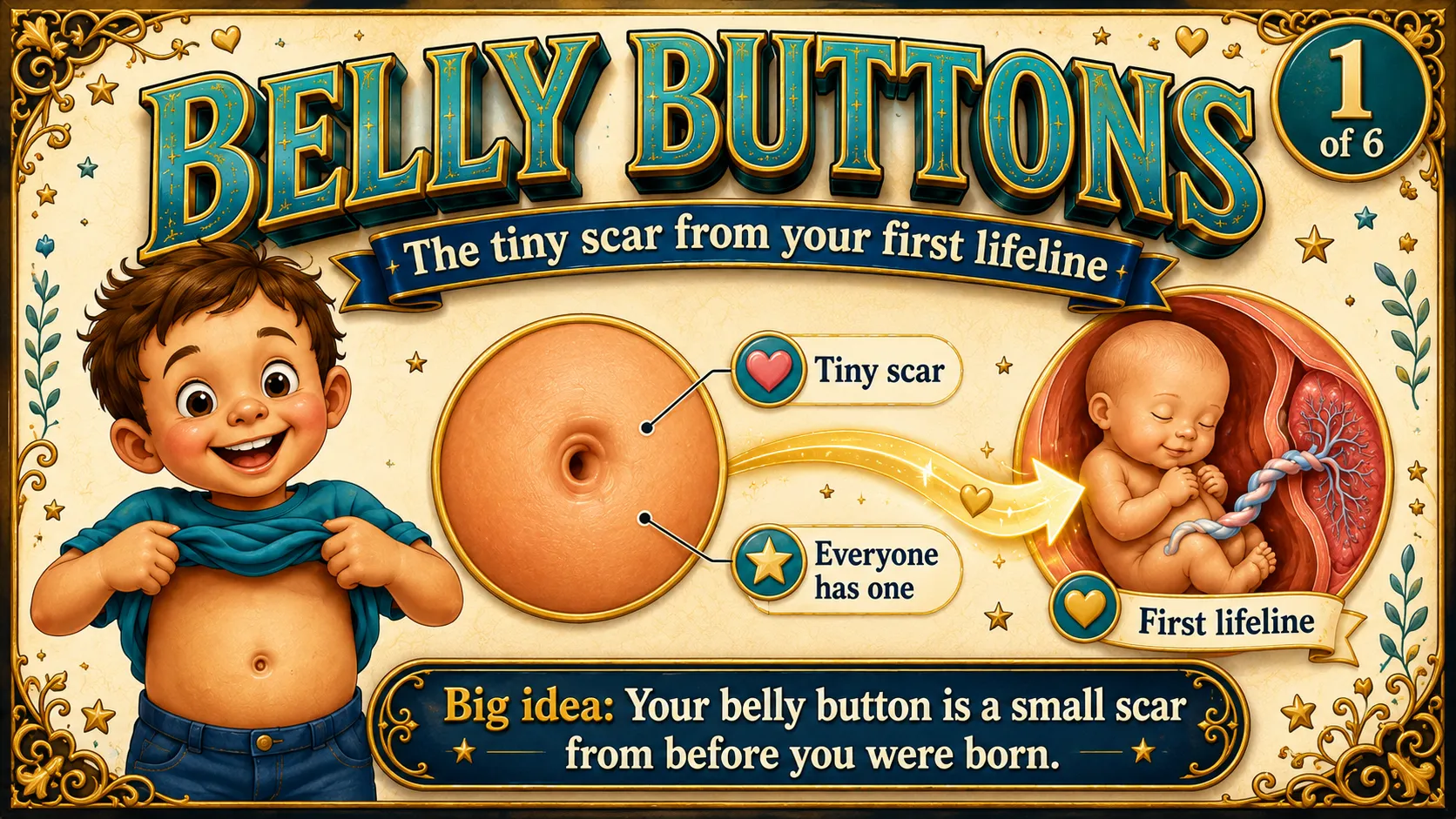
A belly button is a scar. Before you were born, a tube called the umbilical cord joined you to your mother, carrying food and oxygen to help you grow. When you were born, the cord was clamped and cut. The small stump left behind dried up and fell off after a week or two, leaving the little mark we call a belly button.
On Whizbee · carousel slide 1
The big ideas
The cord was your lifeline before birth
A growing baby can’t eat or breathe in the usual way inside its mother. Instead, a tube called the umbilical cord connected you to the placenta — an organ that passed food and oxygen from your mother’s blood into yours, and carried waste away. Everything you needed to grow travelled through that cord.
The belly button is the healed mark left behind
When you were born, you no longer needed the cord, so it was clamped and snipped — this doesn’t hurt, because the cord has no nerves. The short stump left on your tummy slowly dried out and dropped off within a week or two. The skin underneath healed into a small scar: your belly button.
"Innie" or "outie" is just how the scar healed
Some people have a belly button that dips inward (an "innie") and some have one that pokes out a little (an "outie"). This is simply how each person’s scar happened to heal — it isn’t caused by how the cord was cut, and it isn’t a sign of being healthy or unhealthy. Almost all mammals have one too.
A quick quiz
1. What is a belly button, really?
Choices: A special muscle · A scar from where the umbilical cord was attached · A tiny bone
Answer: A scar from where the umbilical cord was attached. A belly button is a scar. It marks the spot where the umbilical cord — the tube that fed you before birth — was once joined to your body.
2. What did the umbilical cord do before you were born?
Choices: Helped you talk · Carried food and oxygen from your mother to you · Kept you warm
Answer: Carried food and oxygen from your mother to you. Inside the womb, you couldn’t eat or breathe the normal way. The cord carried food and oxygen from your mother’s body to yours so you could grow.
3. What decides whether someone has an "innie" or an "outie"?
Choices: How healthy they are · Simply how their belly button scar happened to heal · How the doctor cut the cord
Answer: Simply how their belly button scar happened to heal. "Innie" and "outie" are just different ways the scar healed. It’s not about health, and it’s not caused by how the cord was cut — it’s simply natural variation.
For parents: helping your child think about why we have belly buttons
Belly buttons are a wonderfully personal way into a big idea: every body carries traces of its own history. The best opening question is direct and a little surprising: "Do you know what your belly button actually is?" Most children have never thought to ask, and the answer — it’s a scar — often genuinely astonishes them. From there you can explain the umbilical cord gently and concretely: before they were born, they couldn’t eat or breathe the usual way, so a special tube carried everything they needed straight from their mother. That mental picture makes the belly button feel less like a random dent and more like a meaningful mark of where their life began. A reassuring detail worth sharing: cutting the cord doesn’t hurt, because it has no nerves — children often worry about this. The "innie versus outie" question is a lovely chance to bust a tiny myth: it’s not about health, and not about how the cord was cut, just how each person’s skin happened to heal. That teaches an important habit — not every difference between people has a deep cause; some things are simply natural variation. You can also widen the wonder: nearly every mammal, from a kitten to an elephant, has a belly button for the same reason. Ask your child to explain, in their own words, why they have a belly button — starting from before they were born.
Frequently asked questions
Why do we have belly buttons?
A belly button is a scar marking where the umbilical cord was attached. Before birth, that cord carried food and oxygen from your mother to you. After birth, the cord was cut, dried up, and fell off, leaving the small mark we call a belly button.
Why do some people have an "innie" and others an "outie"?
It simply comes down to how each person’s belly button scar healed. An "outie" is not caused by how the cord was cut, and neither type is healthier than the other — it’s just natural variation between people.
Does cutting the umbilical cord hurt the baby?
No. The umbilical cord has no nerve endings, so cutting it doesn’t hurt the baby or the mother. The small stump left behind simply dries out over a week or two and falls off on its own.
A tutor that asks questions back
Whizbee is a safe AI tutor for ages 7–11 that turns curiosity into real understanding — finite missions, no open chat, and proof of thinking for parents. No scores, no streaks, no ads.
Join the Founder Year